

The 9-to-5 Work From Hotel (WFH) Power Day
Ditching Home Office Chaos for Premium Dayuse Rooms
Book a dayuse hotel room from 9-to-5 for the ultimate distraction-free workspace. High-speed Wi-Fi, quiet calls, and premium amenities beat home offices and coffee shops.
TL;DR
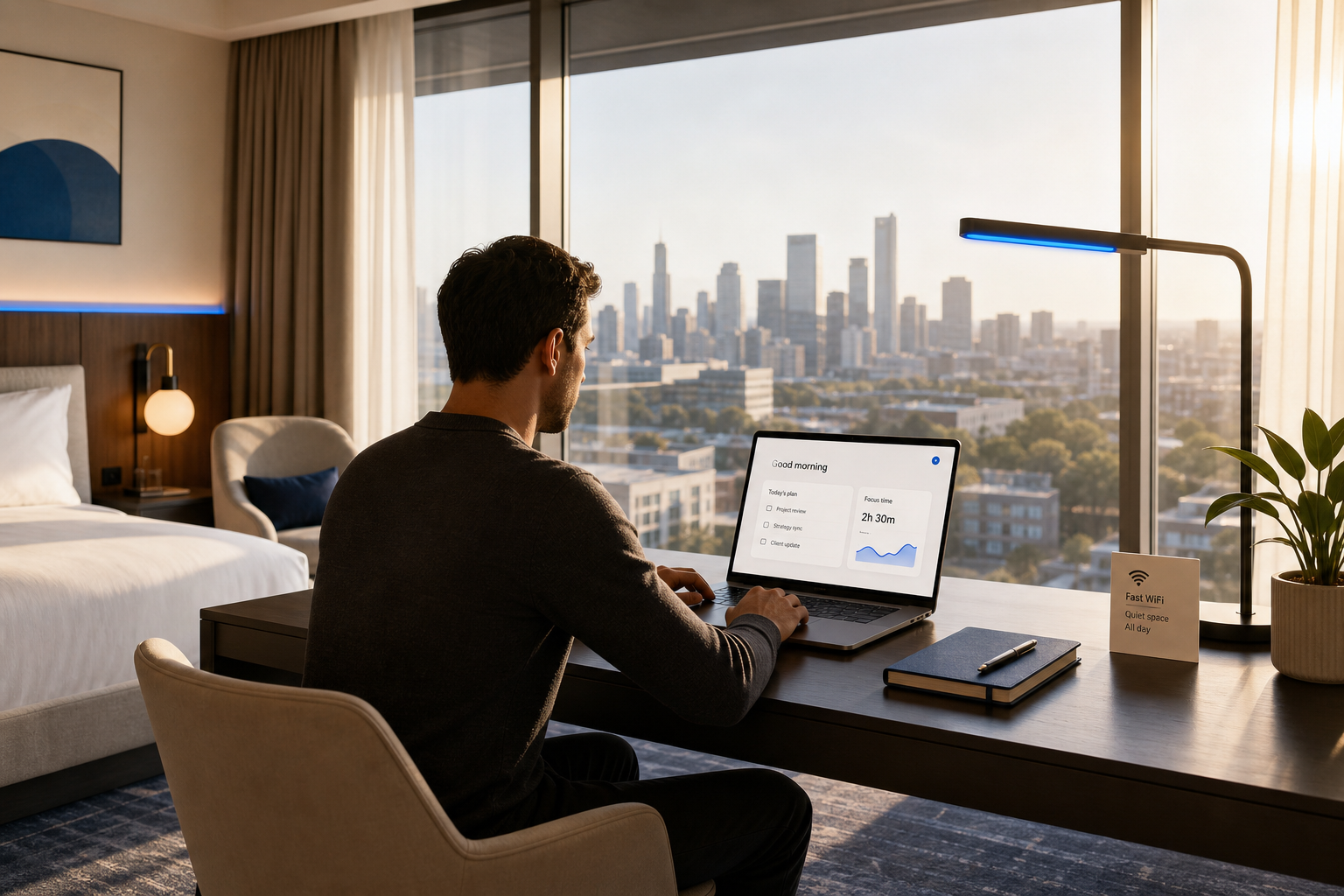
Your home office is a distraction factory. Coffee shops are crowded and chaotic. Coworking memberships are expensive if you only need occasional focused time. Dayuse hotel rooms-booked 9-to-5 for $30-$80-solve all three problems in one. You get a private executive suite with high-speed Wi-Fi, zero interruptions, a professional video call background, and often gym access or lunch included. For remote workers, freelancers, and corporate teams pulling a power day, a dayuse room is the single best productivity investment you'll make this year.
Ditch the Distractions: Why Your Home Office Isn't Cutting It Anymore
The pandemic made remote work possible. Five years in, it's become obvious: working from home is hard.
Your kitchen is three steps away. Your bed whispers from the next room. Your roommate starts a Zoom call at 10 AM, your landlord knocks on the door, your WiFi stutters, and suddenly you've lost focus for the third time before lunch.
Even if you live alone, the psychological weight is real. Research from Stanford and MIT shows that a change of physical environment unlocks cognitive gains-your brain treats a new space as a new task. Staring at the same desk for months, your brain gets stuck in maintenance mode, not creation mode.
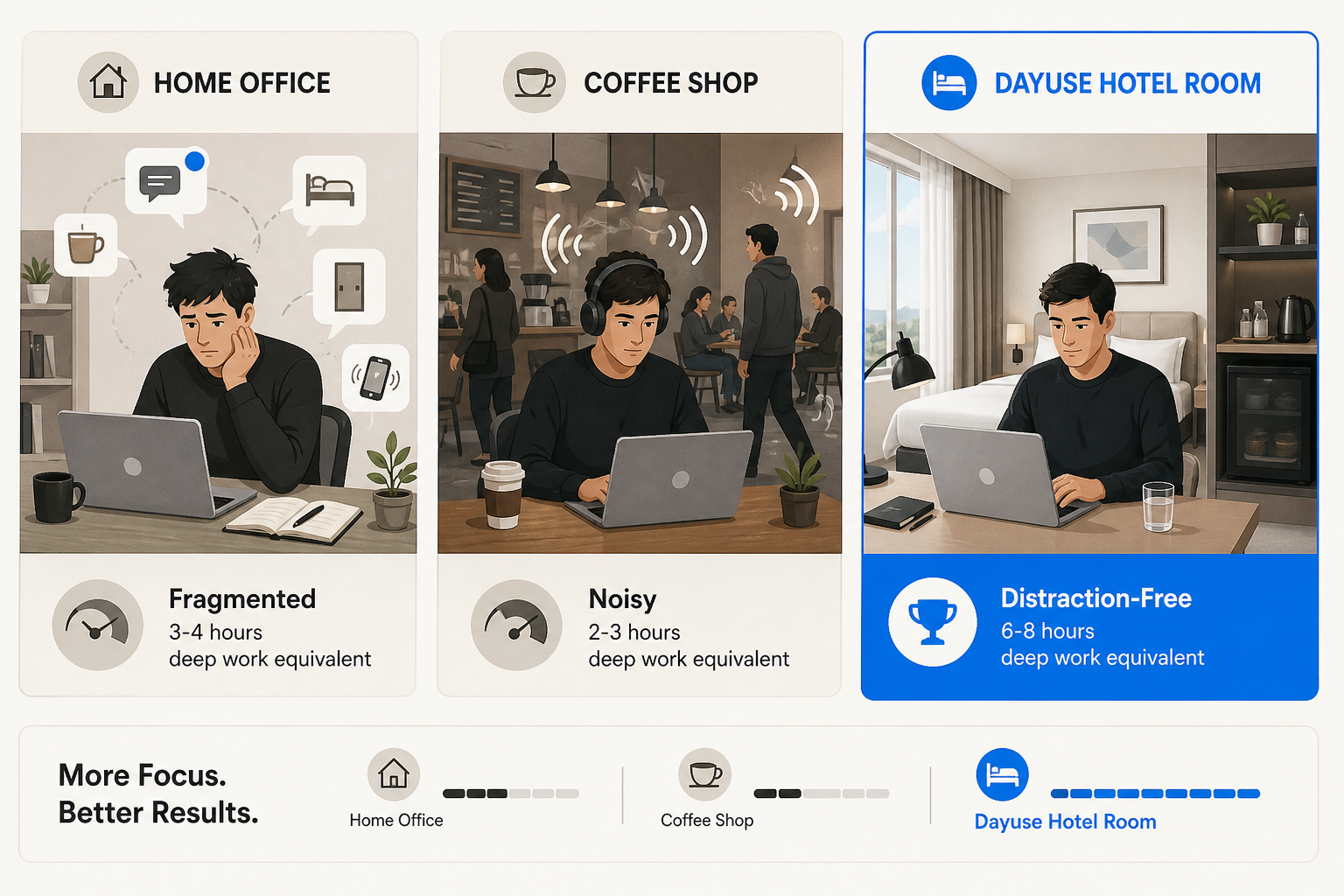
Coworking spaces fix the environment but introduce a new problem: cost and overcommitment. A monthly membership at WeWork, Regus, or a local coworking chain runs $200-$400 (some push $600+). That's great if you go five days a week. It's a waste if you're the remote worker who only needs two or three power days a month to reset, crush a deadline, or take serious client calls.
What if there was a third option? One that gave you the silence of a hotel room, the desk space of a proper office, the cost efficiency of picking when you work, and the psychological reset of a genuinely new environment?
There is. And it's been hiding in plain sight.
Enter the Dayuse Hotel Room: The Secret Productivity Hack Everyone's Sleeping On
A dayuse hotel room is simple: you book a hotel room for the daytime hours (typically 10 AM–6 PM or 9 AM–5 PM) at a fraction of the nightly rate. Instead of paying $150 for a night, you pay $40–$80 for an eight-hour workday.
The economics alone are absurd. Compare:
Home office: free, but chaotic-distraction cost is massive
Coffee shop: free WiFi, $5–$8 per hour (if you're buying drinks)-noisy, unprofessional
Coworking membership: $200–$400/month (assuming 20 workdays/month = $10–$20/hour)-locked into a subscription
Dayuse hotel room: $30–$80 for 8 hours ($3.75–$10/hour)-pay only when you need it
But the value isn't just financial. What you're really buying is:
Silence. A hotel room is sound-engineered to be quiet. No ambient noise, no shared space chatter, no coffee grinders.
Professionalism. Your video call background is now a clean, modern hotel room-not a messy bedroom or kitchen.
Environmental control. You set the temperature, the lighting, the music (or lack thereof), the snacks. No compromising with coworkers or coffee shop ambiance.
Accountability. You booked the space; you're using it. There's psychological weight to a paid day that makes you actually work.
Flexibility. No membership. No commitment. Book when you need it. Cancel if plans change.
For someone doing deep work-writing, coding, designing, strategy-eight uninterrupted hours in a distraction-free environment is exponentially more valuable than eight interrupted hours in your home office or a coffee shop.
Dayuse Hotel Platforms: How to Actually Book One
You don't just call the front desk and ask for a dayuse rate. Instead, specialized platforms have emerged over the last five years to handle this-abstracting the logistics and guaranteeing the availability.
The three biggest are:
Minibreaks
Minibreaks is the most established. Operating across the US and Europe, Minibreaks lets you search thousands of hotels by location, time window, and amenities. The platform handles the full day-rate negotiation with properties, so you book directly at discounted rates.
You get:
Flexible check-in times (9 AM, 10 AM, noon-pick what works)
Check-out from 5 PM to 6 PM depending on property
Full access to the room during your window
Optional add-ons: gym passes ($10–$20), meals ($15–$30), parking
Pricing on Minibreaks typically runs $35–$85 depending on city and hotel tier. Manhattan luxury suites sit at the high end; secondary markets and mid-range chains are $40–$60.
HotelsByDay
HotelsByDay operates a similar model, with a focus on major metros (NYC, LA, SF, Chicago, Miami, Boston). The selection is smaller than Minibreaks, but the user experience is extremely clean-search, filter by price/amenities, book in two clicks.
Prices are comparable: $30–$100 depending on location and property.
Resortsider
Resortsider takes a different angle-it's pitched more toward travelers seeking mid-day breaks during trips, but the remote worker angle is there. Availability is more limited, but if you're in a major resort destination and want a proper break-slash-workday combo, it's an option.
Each platform lets you filter by:
Wi-Fi quality (they label business-grade rooms)
Amenities (gym, parking, meals, spa)
Desk workspace (some rooms have proper workspaces; cheaper rooms may have less comfortable seating)
Noise level (higher floors = quieter)
Pro tip: Book a business or executive suite, never a standard room. The desk is bigger, the chair is actually good, the Wi-Fi is prioritized, and the atmosphere feels like work, not vacation.
What a Power Day Actually Looks Like
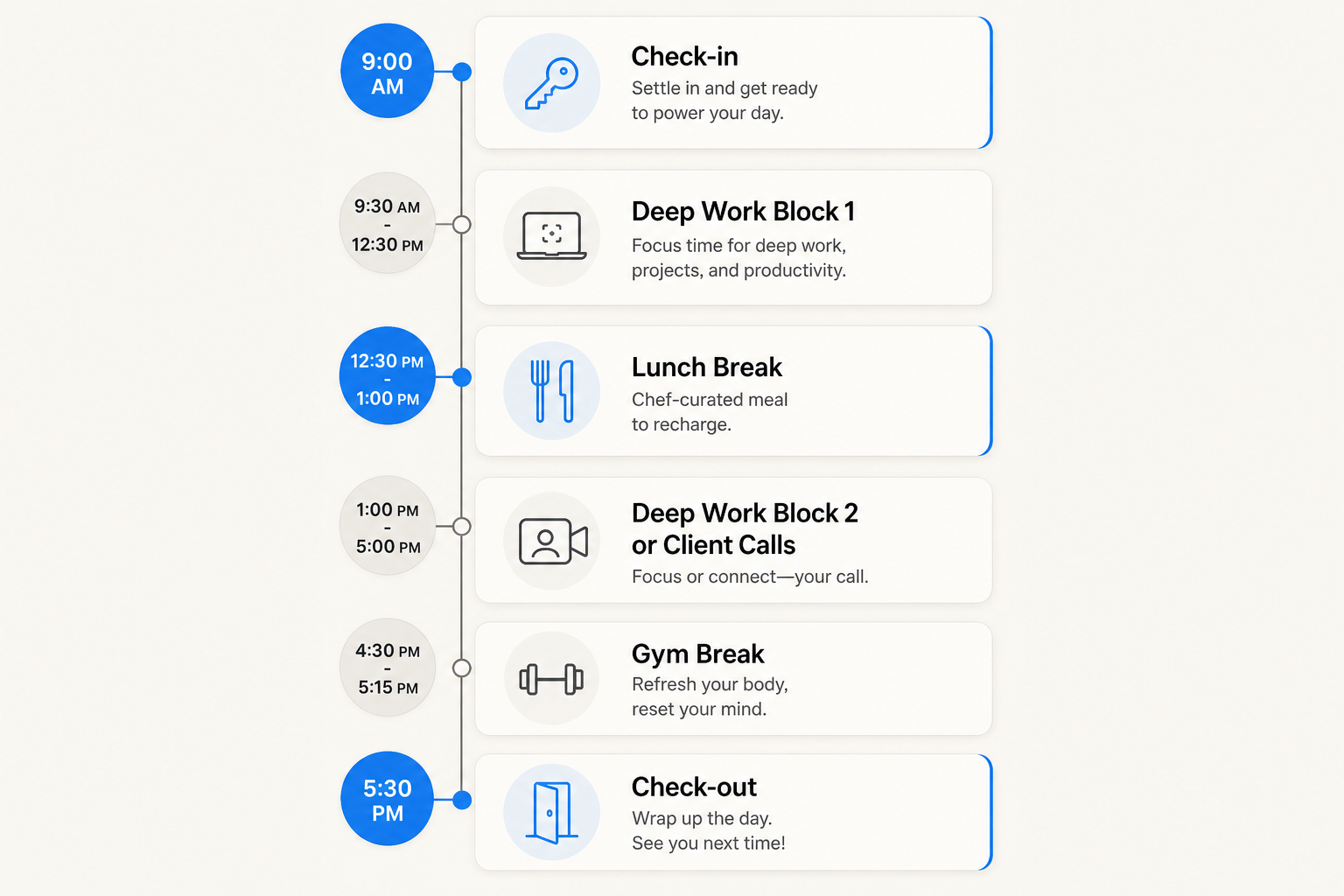
Here's how a dayuse power day usually works:
9:00 AM - Arrive at hotel. Check in (usually requires just your phone/reservation; keycard waiting). Head straight to your room.
9:15 AM - Settle in. Test WiFi (run a quick speed test). Adjust desk/chair. Make coffee from the in-room maker (or order room service). Open your laptop.
9:30 AM–12:30 PM - Deep work block. No emails, no Slack, no context switching. Just the thing you came to do.
12:30 PM–1:00 PM - Lunch break. Many dayuse packages include lunch delivered to your room (chef-curated options from the hotel restaurant). Or you order room service. Or you go down to the hotel cafe.
1:00 PM–5:00 PM - Second deep work block, OR use this time for calls. The quiet environment makes your client calls sharp. No background noise, no apologies for the home office chaos.
5:00 PM–5:30 PM - Wrap. If the hotel offers a gym or spa add-on, hit it for 20 minutes to reset before heading back into your evening.
5:30 PM - Check out. Head home or into your evening, recharged.
Who Should Actually Book a Dayuse Room
Dayuse hotels aren't for everyone. The model works best for:
Freelancers pulling client calls or deadline days-you need silence and professionalism on video. A hotel room delivers both.
Remote employees in hybrid roles-some companies encourage "power days" at shared workspaces; a dayuse room is your alternative.
Sales and customer success teams with back-to-back client calls-no interruptions, professional background, you control the narrative.
Writers, designers, developers, creators on deadline-eight uninterrupted hours compounds. Deep work in a hotel suite can replace two weeks of home office fragmentation.
Teams doing off-site work without the hotel-stay cost-pool your dayuse budgets, all work from the same suite for a day, and you've got an off-site for $100–$150 split four ways.
Anyone needing a psych reset-sometimes you just need to work somewhere different. A dayuse room breaks the home office monotony without derailing your schedule.
It doesn't work great for:
People who need daily, reliable desk space (coworking wins; commitment saves money)
Workers in small towns where dayuse availability is limited (only major metros have options)
Jobs requiring hardware or equipment you can't carry (the room has a desk, not a server rack)
Team collaboration as a primary use case (solo/small team focus is the strength here)
The Dayuse Hotel Advantage: Premium Amenities Included
Here's where dayuse rooms get interesting. Most coworking spaces are bare-desk, chair, WiFi, coffee. Dayuse hotels give you:
Gym access (often included or $10–$20 add-on) – take a break, reset your energy
Chef-curated meals ($15–$30 add-on) – not vending-machine coffee, actual food
Parking – included at most properties (coworking charges extra in cities)
Room service – water, snacks, coffee refills, lunch-all available on your timeline
Professional atmosphere – your video calls look like you're in a real office, not a home setup
These aren't luxuries; they're force multipliers for a power day. A one-hour break in a hotel gym, followed by a real meal delivered to your room, resets your focus for the afternoon in a way a coffee shop never can. You're not just working; you're recharging while you work.
Premium Workday Scenario: The Full Experience
Let's paint a realistic example. You're a freelance designer with a 10 AM client presentation and an afternoon deadline. You book a Minibreaks dayuse room at a Marriott 20 minutes from your client's office.
9:15 AM - Check in. Room is clean, desk is solid, the chair is actually ergonomic. Test the WiFi: 95 Mbps. Rock solid.
9:30 AM–10:00 AM - Prep for the call. Adjust your camera angle. Check your background (clean, professional, brand-aligned). Have your slides open.
10:00 AM–11:30 AM - Client call from the room. No interruptions. No roommate noise. No Alexa mishaps. You sound focused, look professional, and the room reads as competent office space, not home office.
11:30 AM–12:30 PM - Lunch delivered to the room. The hotel restaurant packed a real meal (grilled chicken, roasted veg, bread). You eat while checking your email.
12:30 PM–5:00 PM - Deep design work. Headphones on, Spotify playlist running (hotel ambient tracks), zero interruptions. You ship the revised design, send it to the client, and you're done by 4:30 PM. Normally, this would have taken two fragmented days at home.
4:30 PM–5:15 PM - Gym visit. 30 minutes on the elliptical, 10 minutes in the steam room. Endorphins. You're human again.
5:30 PM - Check out. Head home. Tonight, you're done. No emails, no "let me just finish this one thing." You finished today.
Cost: $65 (room) + $20 (gym) + $0 (lunch included) = $85 for a day that would have taken you 2–3 fragmented days at home.
That's the dayuse value prop.
The Emerging Trend: Dayuse Hotels as the Remote Work Workspace of Choice
Remote work was supposed to be the future. It is. But five years in, we're realizing that always working from home is a trap. The best remote workers aren't the ones chained to a home office-they're the ones who mix environments. Some days home, some days coffee shops (for the ambient social energy), some days a coworking space (for community), and increasingly, some days a dayuse hotel room (for deep work and psychological reset).
Dayuse hotel platforms have grown 300% over the last three years because they solve a real problem that neither home offices nor coworking spaces fully address: you want to work seriously, but you don't want to commit, and you want it to feel special.
A $50 dayuse room feels like an investment in your day in a way a free home office doesn't. You take it seriously. Your brain treats it seriously. The output reflects that.
For 2026, expect to see:
More hotels adopting dayuse rates as a standard offering (currently ~40% of hotels in major metros; growing)
Higher-end hotels entering the market – luxury dayuse options with white-glove service
Corporate partnerships – companies booking dayuse suites for their remote teams' power days (reimbursable business expense)
Wellness packages expanding – dayuse + spa, dayuse + fitness class, dayuse + meal plan combos
The trend is accelerating because the economics work for hotels (high-margin revenue on empty daytime rooms) and the productivity win works for remote workers (less burnout, sharper work, flexibility).
Try a Dayuse Room This Week
You don't need to commit to a coworking membership or accept your home office chaos. Next time you have a deadline, client calls, or just need your brain to work properly, book a dayuse room on Minibreaks, HotelsByDay, or Resortsider.
Spend $50–$80. Get eight uninterrupted hours, a professional background for calls, a gym to reset your energy, and a meal included. You'll ship more work in that day than you usually ship in a week.
The dayuse hotel room isn't a luxury. It's a productivity infrastructure investment. Treat it that way.


